

Singing Ballads at Simon Fraser University
 by Tim Readman
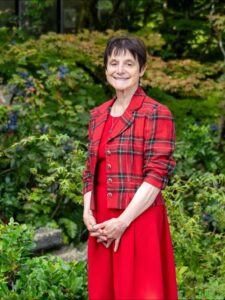
The Vancouver Folk Song Society connects with the broader community in lots of ways. In 2023 Leith Davis, a professor in the Department of English at Simon Fraser University contacted the VFSS with a request for participation in some of her teaching activities. Leith studies and teaches media history and eighteenth-century literature, especially Scottish and Irish literature. She is a keen advocate of bringing music into the classroom to enrich the students’ learning experience. In her invitation she summed up what she was looking for.
“The crucial thing I’m interested in is getting students to think about and to experience singing and listening to singing. Unaccompanied singing is mostly what the ballads would have been. The time period that we’re studying is early, before ballads were defined in any particular way, so they represent a variety of songs. Work songs, songs based on tragic events, comic songs…. basically 40 to 45 minutes of singing, And sing-along. Then questions and comments from students.”
Three VFSS members, Bevan Bartlett, Dylan Brown and Steve Deering came to sing at two of her classes. The first (September, 2023) was a third-year undergraduate class of 25 students: English 320: ‘Wiring The World Before Twitter: Old And New Media In The Eighteenth Century.’ The second (January, 2026) was a boutique graduate course of four students: English 832: ‘Songs, Spectacles and Circuses in the Long Eighteenth-Century.’
“For a long time now, I have invited singers and performers to the classes so my students can better understand what the soundscape of the eighteenth century might have been really like and so that they can experience what happens when listening to and singing ballads. For these two courses, as we were studying early eighteenth-century ballads, I invited Bevan, Dylan and Steve to share their knowledge and love of ballads.”
For both classes, Leith felt it was important for the students to start with the listening and singing before studying any texts. The idea was that the students come and listen and sing without any preconceived notions of what they were experienced. She changed the classroom around so that students were sitting in a circle with no desks, no books and no computers. At first, they were a little unsure about what they should be doing, then Bevan, Dylan and Steve took turns with the lead singing. They presented a whole range of different songs
Here’s the list of songs sung for the English 320 course:
- South Australia (Steve)
- O’er the Hills and Far Away (Dylan)
- Pleasant and Delightful (Bevan)
- Herrin’s Heids (Steve)
- The Tippling Philosophers, a.k.a Wine and Wisdom, a.k.a. Diogenes Surly and Proud (Dylan)
- Lord Randall (Bevan)
- Dumbarton’s Drums (Steve)
- Hard Times of Old England (Dylan)
- The Night Visiting Song (Bevan)
- Wild Mountain Thyme (Bevan)
“Bevan, Dylan and Steve repeated some of these songs for the English 832 course, but did some substitutions (for example, Steve did ‘The Twa Corbies’ (with an impressive Scottish accent) along with an English version of the ballad). And they also shared more information about the ballads and ballad collections with the graduate class than they had with the undergraduates.”
“I could see a fascinating change happening as the students were listening (and especially as some of them also began to join in the choruses). They began leaning in to the circle more, their toes and fingers started tapping, and they appeared to be enjoying themselves (judging by the smiles and nods). The graduate class also became much more animated and engagement was strong.”
At the end of each class, students had opportunities to ask questions of the singers. These included how they learn songs, to how they choose to perform them, to where they learned to sing. A number of students connected with the ballad singing by sharing experiences from their own communities of group singing (usually at rituals such as weddings or religious festivals). Some talked about their memories of songs from their childhood.
“I also did a debrief with each group the following week. They confirmed that they weren’t sure what to expect in the beginning, but they all enjoyed the experience. It helped them understand some of the aspects of singing that we talked about later in the course.”.
“I believe that most students don’t have any experience listening to acoustic and a cappella singing; if they go to concerts, the singers are usually amplified and have back up musicians (also amplified). So listening to and singing ballads is indeed a strange experience for most. It gives them a brief, fleeting understanding of what it might be like to live in a time before streaming, a world like that of eighteenth-century Britain where music and song were generated for the most part by and for the community. Ballads and songs are also ways of building empathy by listening to the perspectives of people who have diverse experiences.”
“This kind of experience is particularly important these days when so much of what students do is done through screens. I think many of them realize the importance of human face-to-face relationships, but listening to songs without the interface of the screen is an important way of practicing being together in community. I could tell that having the singers in the classroom made the class bond more together.”
It’s heartwarming to read these words as an affirmation of everything that VFSS stands for. It helps us to continue to build bridges into all sectors of our community and to promote the activities that we are engaged in.
In conclusion, Leith expressed a lot of interest in continuing to collaborate with VFSS and has some ides for future engagement.
“Huge thanks to Bevan, Dylan and Steve for coming to share their passion for singing with my students. I have given my students information about the VFSS and about the events that happen around Vancouver (including the very popular Monday Night Pubsing at the WISE Club). I would love to find more ways for my students to connect with songs and with the VFSS. I welcome any ideas people might have to build connection between the university community and the VFSS. Would anyone be interested in doing a pub sing on campus, for example? You can contact me at leith@sfu.ca with any ideas you may have.”
Thank you, Professor Leith Davis, and we hope to sing with you and your students again soon.